

The Medium is Still the Message
Every era of disruption follows similar patterns. Learn to read them and you'll know how to handle the changes.
Live long enough and you will find yourself in an era of profound disruption. This time, it is Artificial Intelligence that is changing our world faster than we as individuals or our institutions are able to adapt. For those of us skilled in the domains currently being reshaped, this disruption likely feels existential. And there is truth to this: each technological era redefines what society values.
To make things worse, during times like these, it's hard to find signal in the noise to know what's actually true so we can chart our path forward. Some people predict collapse. Others promise utopia. Many are just selling something. In uncertainty like this, we tend to reach for these simple narratives because they calm our anxiety, even though they rarely prove true.
We are currently suspended between what used to be possible and what is becoming possible. That friction unfolds as a society-wide conversation — part experimentation, part recalibration, part self-examination — about what the new normal ought to be.
Despite how it can seem, technological disruption is not chaos. Change tends to follow cycles. New technologies emerge and mature in similar patterns. Incumbent systems respond in predictable ways. In this essay, we will learn the patterns of change and get an actionable plan for how to navigate this cycle.
Start by filtering out the noise
One particularly useful way to see how we experience the conversation and impact of new technology can be mapped by the Gartner Hype Cycle. For AI (LLMs specifically) it might unfold like this:
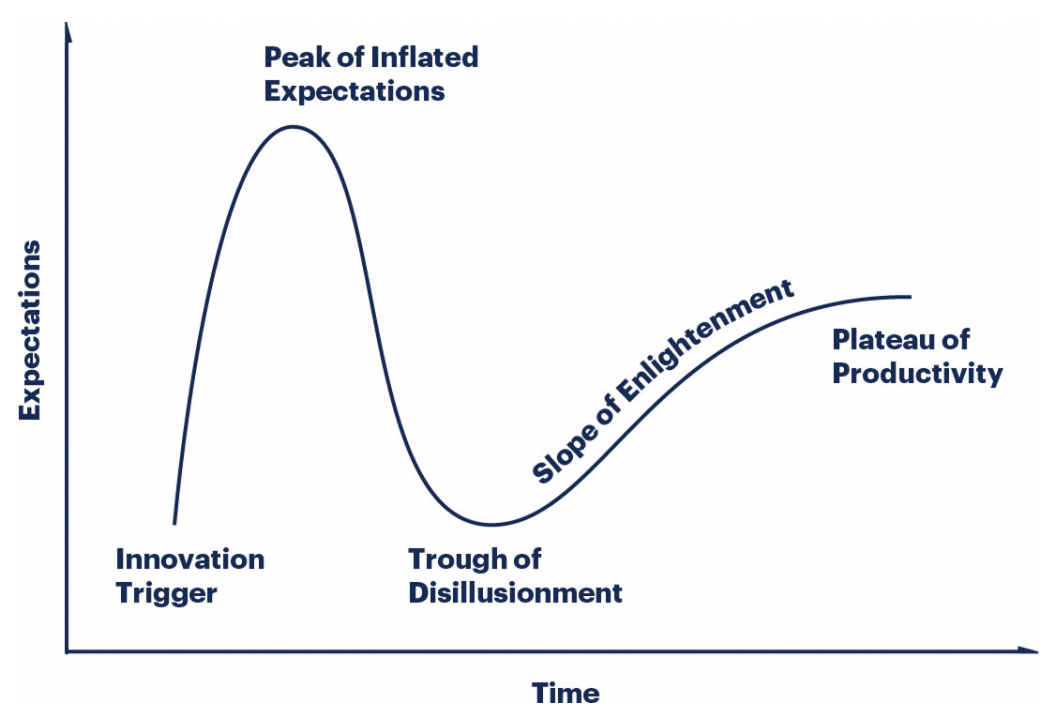
- Innovation trigger: "I just used ChatGPT and it feels like science fiction in real life!"
- Peak of inflated expectations: "AI is going to replace all knowledge work as we know it and we're on the cusp of AGI!"
- Trough of disillusionment: "AI is a bubble! Also, it will destroy us, and it's a waste of time and energy!"
- Slope of enlightenment: "Oh wait, LLMs are still really useful for a lot of stuff"
- Plateau of Productivity: "This is just how things work now"
The Hype Cycle describes how we feel about technological change more than the substance of the change itself. This subjectivity lives in the gap between perceptions and capabilities inherent to an emerging technology, and manifests as the initial hype/doom whiplash.
However, our expectations lie to us when we're early in a cycle because our intuitions are working based on the existing rules and norms. We aren't yet calibrated to properly assess whatever emerges from the period of change.
Media theory offers a useful lens for understanding technological change
Media theory focuses on how technologies shape communication, perception, power, and social organization. Marshal McLuhan, a founding media theorist, summarized that "the medium is the message". He defines "media" as technologies or other extensions of human ability that shape the way we see or act in the world, while the "message" is the cultural conversation and societal impact that happens through and about these media.
McLuhan sought to reorient how we think about media (and technology) by shifting our focus away from each piece of content in a medium, and towards the patterns of content through a medium and their impact on society. Put another way, media theory is less concerned with each thing that is said, and more with what can be said. While this distinction may seem rather meta, it reveals the mechanisms for how media (technology) impact our culture.
Media are not neutral conduits. Independent of its content, every medium structures perception, attention, and social coordination in specific ways — it frames and changes what and how we are able to communicate.1 This is because each medium has its own intrinsic strengths and weaknesses, which shape its unique message. To understand its message, we must understand how a medium works: What senses does it privilege? How does it treat or use time? What kind of thinking does it encourage? How far or evenly does it travel? How is it used to establish trust and legitimacy? Who gets to participate? What behaviors does it reward or disincentivize? What does it make easier or harder? What does it highlight or hide? The answers to these questions form each medium's fingerprint. Together, they determine not just what a medium is good at, but what kinds of social realities it quietly normalizes.
The way media interact with each other behaves like a complex ecosystem. Media tend to settle into roles based on how they're used, but these roles are not fixed because the ecosystem is not static. The introduction of new media reorganizes the system as a whole, and pushes older media towards more specialized (or constrained) roles.2 In practice, the roles media play often feel more intuitive than conscious until they're challenged. For example, you probably know whether you will call, text, DM or email (but not leave a voicemail) based on what you want to communicate and with whom — until a new medium becomes an option.
Putting this theory into practice, each subgenre of "AI" (ML, LLMs, etc) can be thought to function as their own medium because they each affect the flow and impact of information, and have different strengths and weaknesses for shaping human perception worth understanding and exploring. The advent of these technologies as media in the mainstream (ChatGPT's public release in 2023 in particular) triggered an ecosystem reorganization. AI is reshaping what we build, how we build it and how we organize teams towards making new things.
To make sense of how this unfolds, there are different patterns of change for new media and old media that are worth knowing.
New media trigger disruptive innovation
New media start small, but before long they reshape the media around them. This process unfolds as a cycle where new media evolve and mature until they are capable and defined enough to change the way we perceive and communicate.
Early in the cycle this feels turbulent, later in the cycle it feels inevitable, but it evolves along a path of maturity and adoption. Let's understand this by looking at three frameworks that describe the same disruptive innovation process at different scales.
Disruptive innovation across economies
Carlota Perez, in her book Technological Revolutions and Financial Capital, connects technological change to business cycles at a macroeconomic scale.3 In her theory, she describes a process of development along an S-curve.
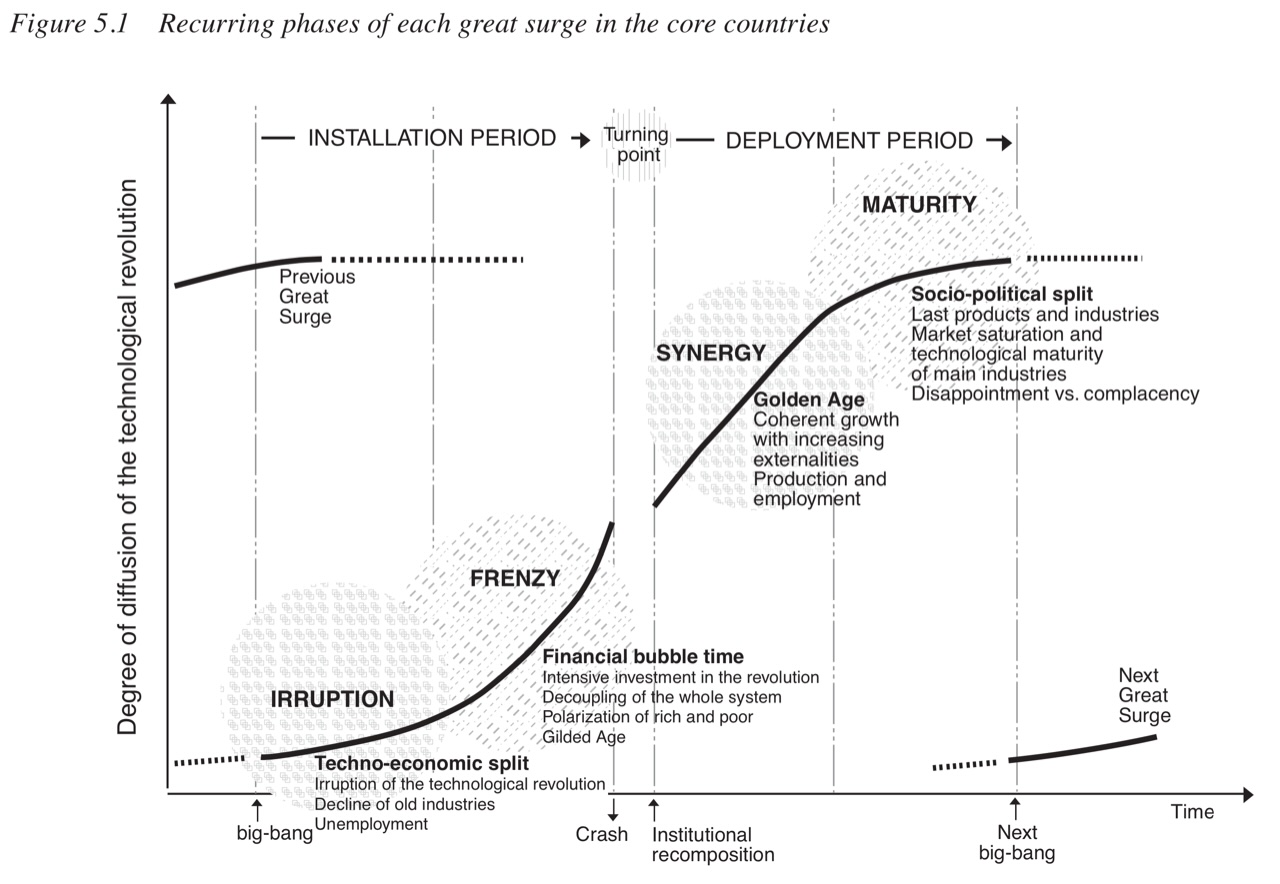
The first stage is the Irruption: this is the early slope where a technology appears and its feasibility is proven through early experimentation. While performance improves rapidly, its uses aren't yet clear. Early adopters experiment and find narrow productivity gains, but they're localized, often undermining incumbents and coexisting awkwardly with the old paradigm.
Second stage is the Frenzy: the new technology starts to catch on and the adoption curve steepens. Financial capital moves in to drive this phase, performing necessary discovery work and funding infrastructure buildout, as it extrapolates future utility. Valuations become detached from real productive capacity and a bubble forms, while old industries are destabilized.
Together these first stages form the "Installation Period" where the new technology evolves and makes a new paradigm possible. This phase is not about widespread utility but testing and proving the new technology and getting capital and infrastructure groundwork in place for it to become useful at scale.
Then comes the Turning Point: there is a crash or stall in the economy profound enough for the new paradigm to break the old one and reorganize the market. This triggers a rethink, regulation and restructuring. Institutions need to be rebuilt.
The last two stages form the "Deployment Period" where the new technology is made to be socially productive. The third stage is Synergy: we renegotiate rules as a society as institutions catch up. Capital shifts from speculative to productive. Productivity and profit grow, employment recovers. Job quality and distribution vary, and new forms of work emerge, if unevenly.
Finally, this gives way to Maturity, the long plateau where real economic utility from the technology is realized at scale. Productive capital drives here, and the technology becomes boring, standardized and widely useful. Productivity gains diffuse across the economy, and growth gets steadier. This becomes the new normal until the next wave starts.
Perez's view is that your experience of a new technology varies based on where on the S-curve you are. She does not prescribe a timeline or focus on adoption speed, but instead describes capital regimes and institutional fit as a cycle. She also explains from an economic and business lens why we see the whiplash in the Hype Cycle: financial capital overshoots infrastructure buildout relative to realizable utility for a duration of time. This is not a flaw with the new technological paradigm, but a cycle-driven temporary dislocation in the economic cycle. She holds that the crash has historically triggered the societal renegotiation needed to harness the infrastructure buildout such that we can realize the new technology's utility.
Disruptive innovation between companies
Clayton Christensen sought to understand how upstart firms so often displace established firms over time, why the incumbents in a market often fail to prevent their disruption, and what might be done in response.4
With his theory of Disruptive Innovation, Christensen observes conditions for a recurring failure mode for companies. He argues that in an effort to satisfy their most profitable customers, incumbent firms steadily improve their product's capabilities until they overshoot what some customers can use or are willing to pay for based on existing measurement of performance or value. This creates room for new firms to enter the market with a product that appears to be inferior by incumbent standards but nonetheless finds a small foothold by either disrupting the low end of the market through being simpler, cheaper or more accessible, or by creating a new market altogether.
The incumbent firm rationally dismisses this upstart because the upstart's offering is initially under-powered or insufficient for their customer base, would provide too low a return on investment if copied, or would cannibalize their core value proposition. The established firm is disincentivized to invest or organizationally unable to protect internal explorations to compete with the new entrant.
Critically, the incumbent firm often misjudges the direction of the market, perhaps by assuming existing measurements of performance will not change, or by underestimating how improvements in new technology can matter. The competitive offering becomes stronger and the upstart firm moves upmarket, threatening the incumbent. Customer expectations of the new technology change the structure of the market faster than the old company can adapt.
It is not that the incumbent firm was unable to see the upstart threat, but rather they are not incentivized to act earlier or decisively. By the time the new expectations or technological paradigm crystalizes, they are too late to respond and they get disrupted. This contributes to why the top ten most valuable companies rarely stay the same over the decades.
Christensen does not argue that incumbent firms are doomed, however. By explaining this pattern, he highlights common failure modes so that they can be navigated. To read a changing market more accurately, he also introduces the concept of "Jobs To Be Done" where he argues that customers don't buy products as much as they hire them to achieve outcomes. Firms that understand the outcomes customers are trying to achieve are better positioned to recognize opportunities for disruption, even if acting on them remains organizationally difficult.
Disruptive innovation within the media ecosystem
McLuhan describes the cycle for how an individual medium matures. There is a gap in time between when the new medium shows up on the stage and when we figure out what best to do with it.
He argues that there is no shortcut: a medium's use is discovered through experimentation, and cannot be assigned or assumed.5 We can't know what a medium is for before we play with it for a while. This process is to figure out what the strengths and weaknesses of the new media are, develop a thesis to interpret how it operates, test it in the world, and see what sticks. In experimentation, we are seeking to develop an intuition for what the new media is and how it might be used by understanding how it affects human perception.
The early experiments of a new medium most often try to be replacements for an old medium. For example, early television imitated radio, early photography imitated painting, and early film imitated theater. However, during this memetic phase, the new medium is judged as inferior by the standards of the old medium. This forces the new medium to keep maturing and evolving to find how it can differentiate itself. The medium grows in capability at the same time that we begin to settle on its conventions, affordances and norms of use.
We often only find enduring uses later in the maturity cycle. It is through continued experimentation that we see where a medium gains broad traction. McLuhan captures this unintuitive truth in his work: usefulness is proven in retrospect, after a medium has been adopted and has been reshaping perception and social coordination.6 From here it carves out its role, and the media ecosystem can settle.
In short: a new medium shows up, then it grows up, then it finds its place, then it becomes the old media.
Disruptive innovation creates new opportunities
All three theorists triangulate the same cycle of disruptive innovation for a new medium/technology: emergence, instability, restructuring, and stabilization. However, they each provide a unique description of the dynamic window that opens earlier in the cycle: Perez explains how new technological paradigms break and reshape the economy, Christensen unpacks why new entrants often displace incumbents, and McLuhan describes how a new medium changes perception and reorders the media ecosystem.
As counterintuitive as it may be, it is in the midst of this early ambiguity when our agency is at its highest. The old way is no longer inevitable. Multiple narratives of our future compete but none are preordained. New uses are discovered, institutions are being reorganized and perceptions are shifting. This is when your participation matters most.
Those who experiment, who build intuition, who publish and share, are the ones who help define the contours of the maturing medium. Once stabilized, the new order will feel obvious and become invisible. But before that happens, there is a period where the story is still being written. The invitation is not to predict from the sidelines but to shape how things unfold.
Old media become obsolete or specialize
Especially if you are invested in an old media, the introduction of new media can feel like a threat. As McLuhan argued, when a new medium appears, it unsettles the entire media environment, pushing older media to reorganize.7
Old media often struggle because they fall for the temptation to have an identity crisis. Initially, most old media either define themselves in opposition to, or try to mimic, the new media. This optional (but common) memetic phase is the mistake of "rear-view thinking" and delays a more mature response.8
McLuhan challenges that it is better to view this process as an ecological change rather than a zero-sum game. Media don't compete per se, they restructure each other.9 With the presence of a new medium, the old medium is forced to confront a change in role. It used to operate as invisible infrastructure for a culture, but now must justify its value and use explicitly.
This process forces old media to respond to new media as they pass through a phase of obsolescence. Obsolescence in McLuhan's view is not extinction but a removal from cultural centrality. Old media don't lose ability, they lose status. How and when we use an old medium becomes scrutinized when its cultural dominance is challenged by a new medium. McLuhan explains that the old medium moves from "ground" to "figure"; or from its invisible role as the default to consciously needing to be chosen for the roles it will hold moving forward.10 Both its weaknesses and strengths become more visible.
When facing obsolescence, a medium can retreat into art and craft or intensify through specialization.11 Both are valid responses but carry different economic consequences. When retreating into art and craft, the medium prioritizes its aesthetic or prestige value but forgoes mass market use and scale. In response to typing, handwriting retreating to the art and craft of calligraphy would provide a good example of this.
Alternately, specialization can happen when a medium, stripped of its assumed authority, is forced to rediscover what it actually does to human perception, and then do only that. This is not a process of obliteration but of distillation.
Let's use an example from art history: painting and the camera. Before the photographic camera was invented in the 1800s, painting functioned as visual record, narrative illustration, and social documentation. But once a camera could render images quicker, cheaper and with more precision, painting lost its default job. Why paint a scene or portrait when you could capture it instantly with a photograph?
Painting as a medium responded to this challenge by distilling down to what it could do that photography could not do: painting became about new ways of seeing, rather than depiction. For example, Monet painted subjective reality, Picasso challenged the representation of time and space, Dali explored surreality, Magritte questioned the object's relationship to its representation, Mondrian rebelled against images needing to be representative at all, and Rothko explored pure color and its effect. People still paint. They just paint different things than they did in 1850.
AI is currently doing to digital product development what the camera did to painting. As tech workers debate this existential threat, we already see both responses predicted by media theory in the discourse: retreat to craft and specialization. The tech sector happens to be ground zero for this disruption, but this likely extends to other industries over time. If we have constructed our identity from our skill in a medium, we will viscerally experience the commoditization. Our initial instinct may be to dismiss it or fight the change.
Specialization is a more defensible response. When the cost of building drops toward zero, the value of knowing what to build rises. The enduring skill of a designer is not in the screens or flows they draw but in the clarity of problem definition and solution; the true measure of a software engineer is not in how many lines of code they write but in the resilience and scalability of the systems they create. It isn't that craft becomes irrelevant, it's that how and what things are made changes with new tools.
What this means for those of us caught in the disruptive innovation process is that we can choose how we will respond to the challenge that new media present to our existing expertise.
What we can do next
While the outcomes of change are unpredictable, knowing the patterns of change makes them navigable. Our goal isn't to find certainty (nobody can), but instead to develop adaptability and build resilience. Here's a four step plan for what to do next:
Process your response to what's changing
It's hard to see clearly with a troubled mind. Whether we are metabolizing overwhelm from hype/doom whiplash, fear of uncertainty, or that our value is under threat, how we respond to a changing world remains within our locus of control. Understanding the patterns of change can make us feel empowered to act. Stay curious and remember how much agency you have.
Experiment to learn new media
Gaining skill in a new medium teaches you to see the world in a new way. Learn how it affects communication, human perception and society: these define its fingerprint. By understanding a medium through experience and watching the experimentations of others, you can develop a 'finger-feel' intuition for how it should be used and have a technically grounded sense of what this new thing can do and shouldn't do. Don't judge it too early. Keep tabs on it as it continues to evolve. The proof of concept can quickly become the new way things are done.
Distill down how we keep using old media
For as much as things change, some things never change. Experience is still a reservoir, even though the application of time-tested knowledge changes. Clarify the unique perspectives that you have because of skill in your medium. Don't get attached to familiar artifacts or existing process but instead abstract these by discerning what outcomes they were intended to achieve. Embrace specialization: what is it that your medium is still the best at communicating?
Explore the adjacent possible
Newcomers may lack experience but they are unburdened by legacy thinking; established practitioners may combat sunk-cost fallacy, but they have developed taste. When we combine understanding of the new ways with distilled wisdom of the old ways, the adjacent possible reveals itself.
What isn't necessary anymore?
What do we no longer have to do without?
What is possible now that was not possible before?
■